
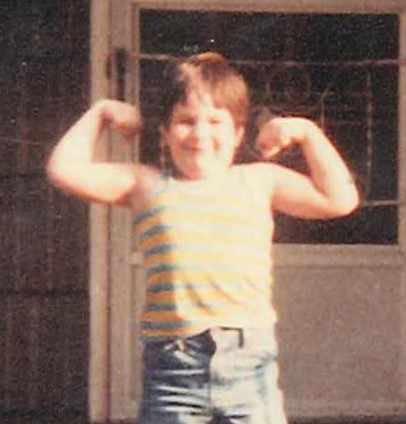
I think it’s a good idea these days to share one’s personal RPG journey, given how there seems to be something of a divide between generations of roleplayers.
Okay, there’s age-based divides about everything. But I still see arguments arise online that cast the OSR and old-school gamers in a negative light. As an antidote, I encourage all “gamers of a certain age” to give their RPG testimonials, to show the youths we’re not all just old people shouting at younger players and new editions.
While I consider myself a grognard in the sense that the word means “old soldier” (because I’ve been at this hobby for about 35 years, off and on), I don’t identify as a curmudgeon. I want to spread the hobby to others before my “real-world campaign” ends and someone staples my mortal character sheet to the cosmic ceiling, you know?
So here goes:
PART I: Portrait of the Gamer as a Young Man (Ages 13 to 18)
I was born in October 1975. Unlike many gamers my age, I had no contact with roleplaying until the late 80s. Unfortunately, I missed out on the original days of Basic and Advanced Dungeons & Dragons. This was due mostly to a very religious upbringing.
My mother was a strict Baptist, and she saw fit to immerse me—her imaginative, bookish, and quiet son—in church dogma. During the height of the Satanic Panic, the preachers at my church warned of the many pitfalls to Hell. One of those devilish traps was, of course, Dungeons & Dragons.
To defend my eternal soul, I was warned to stay away from the wicked game. Of course, I was given the infamous Jack Chick tract, Dark Dungeons, in an attempt to terrify me.
The smear campaign worked…for a while. But eventually, the obligatory teenage rebelliousness arose. I had an inexhaustible imagination, curiosity, and innate open-mindedness, fueled by the many books I devoured (much to the chagrin of my machismo-obsessed father and older brother…you know, ’cause “real men” don’t read).
At the same time (around ’87 or ’88), my childhood pal Pat happened to own several first edition Advanced Dungeons & Dragons books. Pat was a Catholic, and that brand of Christianity didn’t seem as worried about the supposed diabolic influence of Dungeons & Dragons.
As I wrote in another post, I also discovered a book called Stormblade, a novel set in the Dragonlance world. It was my first exposure to fantasy fiction related to Dungeons & Dragons, and served to further deepen my interest the game.
The Golden Age
One day, I borrowed Pat’s copy of the Player’s Handbook, and left it sitting out in my room while I went to school. I came home to find my mom crying about how she found the book and was worried I would go to Hell (the one ruled by Satan, not the cool one with Orcus and friends). The absurdity of it all was the last straw for me. I decided to take the chance that I wouldn’t roast for eternity because I pretended to be an elf and go on quests for imaginary treasure.
Thus began my youthful “golden age” of roleplaying, a span of roughly two years (13 to 15) when everything was new. We roleplayed on nights and weekends with the gusto and near-limitless free time of children.
I can still see myself and Pat and our friends (primarily Pat’s brother Sean as well as our buddies Jay and Dan) gaming in our bedrooms and at kitchen tables. When we weren’t playing, we’d spend hours reading the D&D tomes in our possession. We argued over rules sometimes, and marveled at the arcane and obtuse nature of High Gygaxian writing. We created countless characters, and started so many campaigns that never seemed to last more than a few weeks. We also took turns DMing, but eventually I settled into the role of “forever DM.”
From Golden to Gilded
Inexorably, time went on, as it does. And our attentions were drawn further and further away from D&D as we journeyed through the teens. The distractions of high school drama, girls, sports, and other pastimes like video games and good-old-fashioned TV ate up precious time (oh, how we squandered it).
Between the ages of 15 and 18, we moved from the gloriously baroque language and black & white art of 1st edition AD&D to the more organized ruleset and color art of 2nd edition (the latter looms particularly large in my personal D&D nostalgia).
We also branched out to explore other RPGs. My group delved into Palladium RPGs. We played Teenage Mutant Ninja Turtles, Ninjas & Superspies, Heroes Unlimited, and above all, Rifts.
We began to “disrespect the elder” that was D&D, viewing it with some disdain. It became a “kid’s game” in our young minds. We were becoming adults, and wanted games suited for adults. Or so we thought. Looking back, what we really sought was an experience beyond either loot and slaughter or heroic quests to save imperiled kingdoms.
The golden shine of Dungeons & Dragons had become a gilded bauble.
Graduation from high school was a liberation from the prison of false hierarchy. The summer after graduation, I found myself preparing for the most important quest of my young life: the inner journey of self-actualization!
Okay, that’s grandiose. I was actually just excited to break the last lingering bonds of being treated like a kid, and maybe throw some partying into the mix. But I was also looking forward to taking my scholarly demeanor to the next level.
Just as I had moved away from D&D from a gaming standpoint, I had also determined that modern fantasy fiction was no match for the great Canon of Literature. My eyes firmly set on an English degree, I entered Rutgers University with a head full of dreams and great expectations.
I thought I was done with roleplaying. But I would soon find out, it wasn’t done with me.
(continued in Part II)


 Silverbeard Games
Leave a comment!